FiAPC®plus
Designed to provide enhanced control for a variety of applications, instilling confidence in delivering APC® therapy.
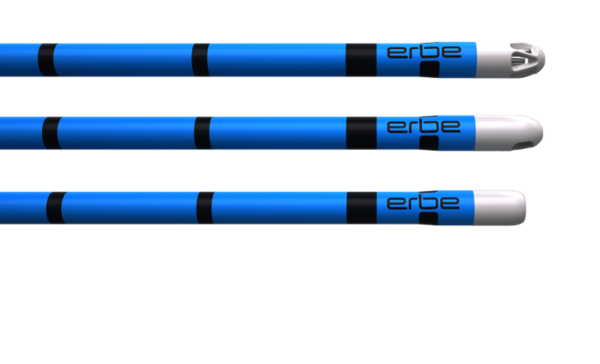
REF No. 20132-325 FiAPC® plus, circumferential, Ø 2.3 mm, length 2.2 m
REF No. 20132-324 FiAPC® plus, side fire, Ø 2.3 mm, length 2.2 m
REF No. 20132-321 FiAPC® plus, axial, Ø 2.3 mm, length 2.2 m
REF No. 20132-323 FiAPC® plus, axial, Ø 2.3 mm, length 3.0 m
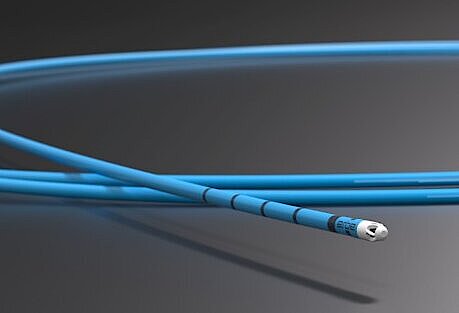
- The flexible FiAPC probes are intended for argon plasma coagulation and ablation of tissue.
- Rapid superficial coagulation of diffuse bleeding for uniform hemostasis.
- Efficient and self-limiting penetration, particularly for thin-walled, hollow organs (e.g., cecum and right colon), reducing risk of perforation.
- Ablative volume reduction can produce substantial mass reduction or debulking (e.g., large airway mass, stent ingrowth and overgrowth). A combination of higher settings and longer activation times result in tissue vaporization, shrinkage, and late necrosis.
- APC® is used for the coagulation of diffuse bleeding and the ablation of tissue through vaporization and shrinkage.
- APC® is a monopolar electrosurgical modality that delivers electrosurgical energy to target tissue via conductive, ionized argon plasma.
- The FiAPC® plus probes are designed to provide enhanced control for a variety of applications, instilling confidence in delivering APC® therapy.
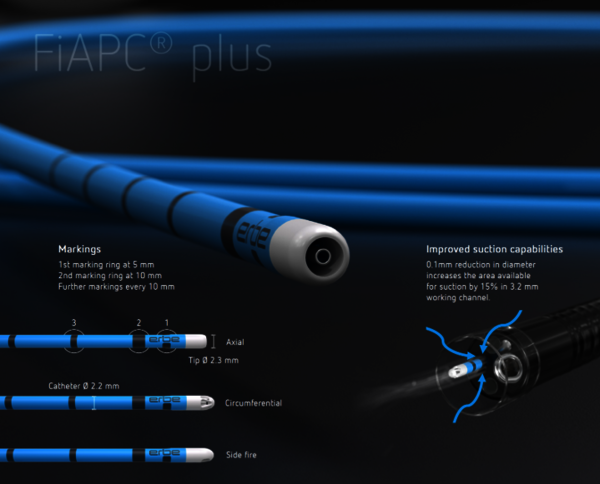
- Various distal tip designs of the FiAPC® plus probes facilitate a range of coagulation and ablation techniques, e.g. en face, tangential, circumferential application
- Enhanced tissue effect: reliable, reproducible, and homogenous
- FiAPC® plus electrodes: designed with a proprietary coating for better heat conductivity, reducing heat developed at the distal end of the probe, potentially reducing the tissue sticking effect due to high temperatures.
- Ergonomic plug design: for ease of handling, visual identification of the integrated filter, and connection to the APC® module
- Distal instrument markings: facilitate depth and orientation of the instrument within the endoscopic view
- Smooth passage through the working channel of the endoscope, even in retroflection and tortuous anatomies
- Rounded, atraumatic ceramic probe tip: intended to glide along mucosal surfaces to provide better articulation along target tissue
- Improved suction capabilities: 0.1mm reduction in diameter increases the area available for suction by 15% in 3.2 mm working channel
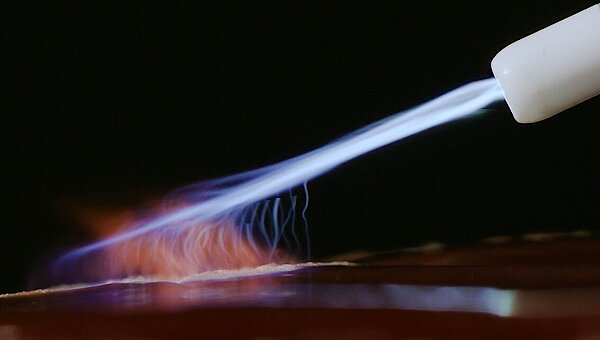
- The proprietary architecture of the FiAPC® plus probes is designed to provide optimized Argon ignition and plasma beam characteristics at lower flow rates which further enhances APC® waveforms.
- preciseAPC® is used for coagulation or ablation, largely independent of the distance between the probe and tissue, particularly in the low-energy range and for thermosensitive areas, thin-walled structures to facilitate coagulation with minimal thermal spread.
- pulsedAPC® delivers pulses of plasma (ionized Argon gas) in either slow or fast pulses, resulting in controlled and generally more superficial tissue effect. This mode is generally used for hemostasis of diffuse areas of bleeding, devitalization, and reduction of tissue with emphasis on controlled power output (e.g. thermosensitive areas, thin-walled structures). While more superficial in nature, long activation periods, and/or higher effect settings can cause significant and deep ablation of tissue.
- forcedAPC® is a "standard," fast and effective APC mode with ignition assistance for reliable and reproducible plasma ignition in ever-changing environment of resistance variables. This mode is generally used for coagulation of diffuse areas of bleeding, devitalization, ablation, and volume reduction of tissue.